|

BREED HISTORY,
STANDARDS,
FACTS

RAMBOUILLET HISTORY
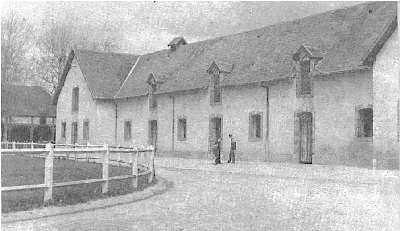
Sheep
barns at the Experiment Station in Rambouillet, France.
The Rambouillet had its origin among the Moors of
North Africa during the Fourteenth Century. Distant
ancestors of today's Rambouillet accompanied Moorish
conquerors to Spain, and their descendants were left
behind when the Spaniards drove the invaders out.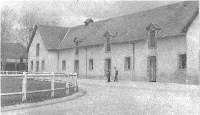
Spain's resulting Merinos were a valuable legacy of
that otherwise unhappy period, along with Europe's first
true horse culture. Both were jealously guarded. The
quality of Merino wool allowed the Spaniards to dominate
the European wool trade, and to maintain that dominance
the government strictly forbade export of the precious
breed. Spain did export much of its raw wool clip,
however, for lack of sufficient processing capacity.
Neighboring France was a major buyer and became heavily
dependent upon a stable supply to keep its own mills in
operation. By the mid-eighteenth century, the French began
to fear that increasing Spanish industrialization might
lead to an embargo on Merino wool as well as Merino sheep.
That concern and the desire to develop domestic
production to offset it may have played a large part in
Louis XVI's establishment of the experimental farm at his
Rambouillet estate. The farm was advertised as a place
where examples of the choicest plants and animals from
around the world would be studied. High on the list, if it
could be obtained, was the Spanish Merino.
If such
flattery was a ploy, it worked where direct entreaties had
failed. As a gift to his cousin Louis, the King of Spain
ordered that a small flock representing the finest strains
of Merinos be released for export to the Rambouillet farm.
A total of 318 ewes, 41 rams and 7 wethers arrived at
Rambouillet on October 12, 1786.
It was the first
significant release of Merinos to the outside world and
except for one small addition provided the sole basis of
the eventual Rambouillet breed.
Within the next few
years the Spanish empire began to crumble and Merinos
found their way throughout the globe, mixing and mingling
with various other breeds and types. The strain assembled
at Rambouillet remained unusually pure, however, even
through the tumult of the French Revolution when their
owner lost both the throne and his head. Parceled out to a
handful of dedicated caretakers, the Rambouillet Merinos
not only maintained their superior fine-wool
characteristics but also developed a body size and
confirmation seldom seen outside the mutton breeds.
By
the mid-1800s a few American breeders had begun importing
Rambouillet rams to cross onto domestic flocks, primarily
the by-then common and somewhat deteriorated Merinos. A
select group of American sheepmen, however, attempted to
emulate the small clique of Europeans who maintained pure
Rambouillet stock.
This led to a split between the
Purists and those who attempted to graft the Rambouillet
name on a cross bred offering. The culmination of that
rift was the 1889 meeting that produced the Rambouillet
Association.
A tract in an early edition of the annual
American Rambouillet Record elaborated in some detail on
the concerns that brought the association into existence.
Its anonymous author wrote that "most" of the early
importations of Rambouillet rams into America were used to
increase fleece bulk on existing Merinos and to improve
their "size, vigor and constitution".
Unfortunately, he
continued, this tended to reduce total fleece weight,
which in the more common Merinos was often a result of
excessive grease. In response, many breeders shifted
selection toward "the greatest possible weight of fleece
in proportion to the weight of carcass, regardless of the
proportion of scoured wool to the raw material".
In
short, they bred the grease back into the point where it
formed "a black crust on the surface of the wool". They
also sacrificed frame size in the process, returning
nearer and nearer to the common Merino while retaining the
Rambouillet name.
This practice was aided and
abetted by the Civil War, when demand for wool soared and
buyers were unable to discriminate against heavy-shrinking
clips. Consequently, the Record explained, "nearly all of
the pure races of the French Merino disappeared",
jeopardizing not only the wool attributes that had been
bred into them, but their near mutton-breed carcasses as
well.
It was to preserve those dwindling numbers of
pure Rambouillet that the Association was formed. It
became permanent with its 1890 meeting, and soon afterward
began publishing the Record.
The first issue lists
Grinnell as president; L. B. Townsend of Vancouver,
Washington, vice-president; L. G. Townsend of lonia,
Michigan, as treasurer; and Samuel D. Pierson of lonia as
secretary. By 1892, L. B. Townsend was shown to reside in
lonia, Michigan, along with L. B. Townsend, so all of the
group's original members were essentially Michigan men, as
were the two directors who did not otherwise serve as
officers.
In addition to the six officers and
directors, the Association appointed a judge whose task it
was to "rigidly examine every flock and reject any and all
sheep or flocks regarding which there was the slightest
doubt as to purity of race". The first Record includes
only six flocks which survived the cut.
"Some flocks were entirely rejected and permanently
excluded from record," the publication stated with
finality. Sheep which qualified for registration were to
be permanently identified "by means of metal ear-tags",
with name and number stamped thereon.
Today, the
association is located in Levelland, Texas and the
registry has been out-sourced to Kansas. All pertinent
past records have been moved to a climate controlled
building on the campus of Angelo State University in San
Angelo Texas. Records dating back to 1893 are encased to
preserve our history.
|
BREED STANDARDS FOR EXCELLENCE
Head
Face free from wool around and under eyes to insure good
vision, and large nostrils, lips thick and pink. Eyes
large clear, alert and well set, eyelashes light in
color. Ears medium in length and free from excessive
pigmentation. Rams – Strongly masculine and bold, medium
length, wide between the eyes and ears. Horns – well
developed with wide spirals to prevent crowding neck and
jaw.Polled – free from scurs. Ewes – distinctly feminine
and refined.
Neck & Shoulders
Free from folds, medium length, blending neatly into
moderate well rounded shoulders that are not open, sharp,
or prominent.
Chest – Broad, deep and full. Back &
Loin – Strong, straight and broad. Long in length with a
long, wide loin and a thick, natural flesh
covering throughout.
Ribs – Well sprung, wide, and
deep, with a full heart girth assuring good capacity for
vital organs.
Rump – Long level and wide, carrying
width well out to dock. Dock free of skin folds.
Leg – Thickly muscled. Well filled out with deep twist;
free from folds.
Feet & Legs – Straight and strong,
with good bone for age. Medium in length and set squarely
on the corners, free from colored hair. Pasterns strong
and up-right; hooves amber colored and free from excess
pigmentation. Should move freely.
Body
General Appearance – Stylish, alert, active, and
well-balanced showing distinct RAMBOUILLET
characteristics. Well developed for age. Deep and wide
bodies, with a straight top and underlines, showing
desirable body confirmation.
Rams – strongly masculine
Ewes – distinctly feminine.
Fleece
General Appearance & Condition – Attractive, bright,
uniform, dense fleece of high yielding, long staple, fine
wool. Cream to white in color. Free from objectionable
fibers. Bright and healthy pink skin. Forehead covered,
but not wooled sufficiently around eyes to obstruct
vision.
Length of staple – Sheep in good condition
should produce a minimum of 4 ½ inches for 12 months of
growth.
Density – The fleece should be as dense as
possible (Maximum number of fibers per square inch of body
surface.) Belly well covered and minimum bare areas in the
flanks and armpits. Density, staple length, and body
surface largely determines amount of clean wool. A large
amount of skin exposed when fleece is parted indicated a
lack of density.
Fineness & Character – Should be
uniform in grade over body. Well defined, uniform, sharp
crimp from base to top and uniform over whole body. Bulky,
soft, and pliable to the touch also sound throughout. Free
of kinks and objectionable fibers.
Rams – grade: 60’s
– 64’s
Ewes – grade: 64’s – 70’s
Disqualifications
Abnormal development of
testicles or only one testicle descended in the
scrotum.Unsound udder or inverted teats.Overshot or
undershot jaw.Black spot in the fleece.Rolled under
eyelids. Weak pasterns. |
Discriminate Against
Black
spot on any portion of the sheep.Wool blindness.Scurs on
polled rams.Neck or body folds.Medial folds on rump
or britch.Kemp or other undesirable fibers.Close horns
that pinch the neck or jaws.Any defect that may limit
usefulness. |
 |
BREED FACTS
WOOL
The Rambouillet is known for its superior, long staple,
dense, fine wool. But, what does this mean to the
producer? A light-shrinking staple of three inches or
better results in greater thread length hence more thread
produced per pound of wool. Fine wool means the threads
are thinner and finer, again resulting in a higher thread
count. Put the two together and an ewe's wool produces a
premium price on the market. The average ewe will shear
about ten pounds or more of wool each year. This wool is
used in finer, worsted fabrics and choice scarves.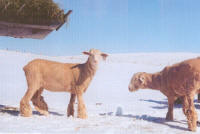
HORNS VS. POLLS
Some breeders just prefer Horned rams over Polled rams. No
matter what purpose the ram is used for, there is no
difference in performance on tests - in the show ring, or
in the flock.
REASONS FOR RAISING
RAMBOUILLET SHEEP
Big,
hardy and vigorous; Great adaptability to hot and cold
climates, and a variety of forage conditions;Will travel
long distances to forage; Good gains on grass; Excellent
foundation on a crossbreeding program;Ewes are prolific;
Good milkers with strong maternal instinct; Excellent wool
production; Superior out-of-season breeders suitable for
an accelerated lambing program; Known as the "Dual
Purpose" breed with excellent fleece and weight gains;
Ewes have less lambing difficulties with less death of
offspring and ewe as a result.
EASE OF CARE
Well developed flocking
instinct to band together in open areas Easy to handle in
yards, chutes and sorting facilities Resistance to
internal parasites and disease Grazing animals needing
minimal labor. This equals less input of labor and
capital, less health expenses resulting in more profits!
JUST THE FACTS
Mature rams weigh about 250-300 lbs. Mature ewes weigh
about 200-275 lbs. Lifespan can be upwards of 10-12
years*. The average ewe will have 1-2 lambs per birth* The
average ewe may lamb more than once per year* Mature ewe
fleece will weigh 8 to 18 lbs. with a yield of 35-55% .
* These results occur if under a carefully planned
management program.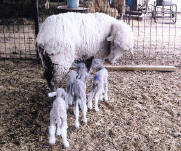
VERSATILITY OF THE RAMBOUILLET
Meat - Wool - Breeding - Youth
Projects - Showing
To assure breeders of their
Rambouillet ram's performance, an annual central
performance test has been continued at the Sonora Station
in Sonora, Texas since 1948. This and other test stations
across the U.S. show the superior genetic performance of
Rambouillet stock.
|
| |
|
|
| |
|
 |